


Page 92 - LIT-18626-15-26
P. 92
UF5R10E0.book Page 83 Friday, September 27, 2024 5:44 PM
Operation
(7) Attach the engine shut-off cord (lanyard)
to your left wrist, and then attach the clip
to the engine shut-off switch.
(8) Look in all directions, start the engine,
and then start off slowly.
EJU33085
Starting off
EWJ00714
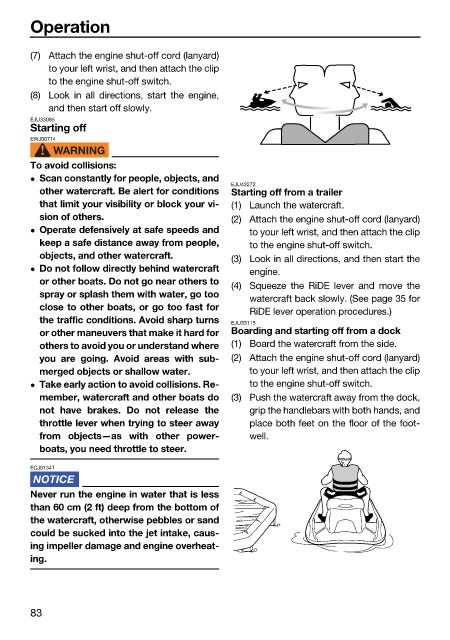
To avoid collisions:
Scan constantly for people, objects, and
EJU43272
other watercraft. Be alert for conditions Starting off from a trailer
that limit your visibility or block your vi- (1) Launch the watercraft.
sion of others. (2) Attach the engine shut-off cord (lanyard)
Operate defensively at safe speeds and to your left wrist, and then attach the clip
keep a safe distance away from people, to the engine shut-off switch.
objects, and other watercraft. (3) Look in all directions, and then start the
Do not follow directly behind watercraft engine.
or other boats. Do not go near others to
(4) Squeeze the RiDE lever and move the
spray or splash them with water, go too
watercraft back slowly. (See page 35 for
close to other boats, or go too fast for
RiDE lever operation procedures.)
the traffic conditions. Avoid sharp turns EJU33115
or other maneuvers that make it hard for Boarding and starting off from a dock
others to avoid you or understand where (1) Board the watercraft from the side.
you are going. Avoid areas with sub- (2) Attach the engine shut-off cord (lanyard)
merged objects or shallow water. to your left wrist, and then attach the clip
Take early action to avoid collisions. Re- to the engine shut-off switch.
member, watercraft and other boats do (3) Push the watercraft away from the dock,
not have brakes. Do not release the grip the handlebars with both hands, and
throttle lever when trying to steer away place both feet on the floor of the foot-
from objects—as with other power- well.
boats, you need throttle to steer.
ECJ01341
Never run the engine in water that is less
than 60 cm (2 ft) deep from the bottom of
the watercraft, otherwise pebbles or sand
could be sucked into the jet intake, caus-
ing impeller damage and engine overheat-
ing.
83

