


Page 22 - LIT-18626-15-27
P. 22
UF5S10E0.book Page 12 Monday, September 23, 2024 2:13 PM
Safety information
lever located at the left handlebar grip can As with any water sport, you should not op-
be used to change the direction of the jet erate your watercraft without someone else
thrust so that the watercraft moves in re- nearby. If you operate further than swim-
verse or is in neutral. The RiDE system as- ming distance from shore, you should be
sists the operator when slowing down and accompanied by another boat or water-
during slow-speed maneuvering, such as craft, but make sure you stay a safe dis-
launching, beaching, and docking. tance away. It’s good, common sense.
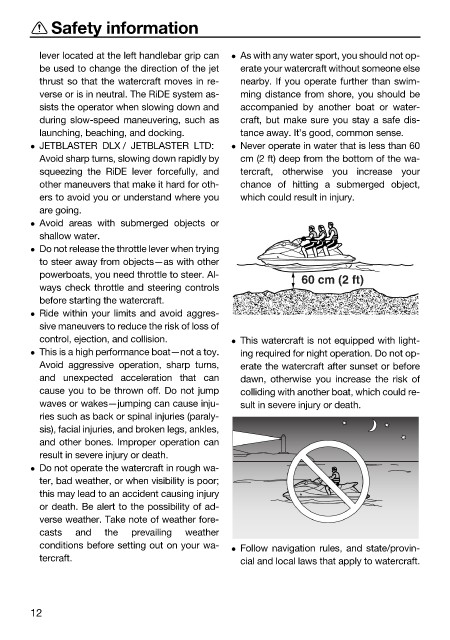
JETBLASTER DLX / JETBLASTER LTD: Never operate in water that is less than 60
Avoid sharp turns, slowing down rapidly by cm (2 ft) deep from the bottom of the wa-
squeezing the RiDE lever forcefully, and tercraft, otherwise you increase your
other maneuvers that make it hard for oth- chance of hitting a submerged object,
ers to avoid you or understand where you which could result in injury.
are going.
Avoid areas with submerged objects or
shallow water.
Do not release the throttle lever when trying
to steer away from objects—as with other
powerboats, you need throttle to steer. Al- 60 cm (2 ft)
ways check throttle and steering controls
before starting the watercraft.
Ride within your limits and avoid aggres-
sive maneuvers to reduce the risk of loss of
control, ejection, and collision. This watercraft is not equipped with light-
This is a high performance boat—not a toy. ing required for night operation. Do not op-
Avoid aggressive operation, sharp turns, erate the watercraft after sunset or before
and unexpected acceleration that can dawn, otherwise you increase the risk of
cause you to be thrown off. Do not jump colliding with another boat, which could re-
waves or wakes—jumping can cause inju- sult in severe injury or death.
ries such as back or spinal injuries (paraly-
sis), facial injuries, and broken legs, ankles,
and other bones. Improper operation can
result in severe injury or death.
Do not operate the watercraft in rough wa-
ter, bad weather, or when visibility is poor;
this may lead to an accident causing injury
or death. Be alert to the possibility of ad-
verse weather. Take note of weather fore-
casts and the prevailing weather
conditions before setting out on your wa- Follow navigation rules, and state/provin-
tercraft. cial and local laws that apply to watercraft.
12

