


Page 16 - LIT-18626-12-56
P. 16
Safety information


       EJU30774                               in certain  kinds  of  accidents and that it
           Operation requirements
                                              could injure you in others.
       z All riders must wear a personal flotation de-
                                              A helmet is designed to provide some head
        vice (PFD) that is approved by the appro-
                                              protection. Although helmets cannot pro-
        priate authorities and  is  suitable for
                                              tect against all foreseeable impacts, a hel-
        personal watercraft use.
                                              met might reduce your injuries in a collision
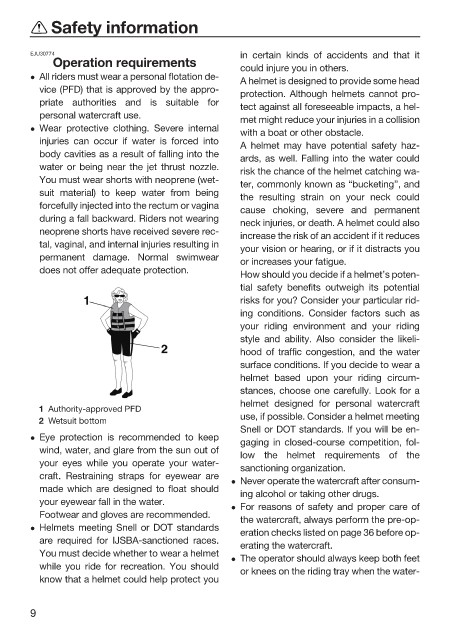
       z Wear protective clothing. Severe internal
                                              with a boat or other obstacle.
        injuries can occur if water is forced into
                                              A helmet may have potential safety haz-
        body cavities as a result of falling into the
                                              ards, as well. Falling into the water could
        water or being near the jet thrust nozzle.
                                              risk the chance of the helmet catching wa-
        You must wear shorts with neoprene (wet-
                                              ter, commonly known as “bucketing”, and
        suit material) to keep water from  being
                                              the resulting strain on your neck could
        forcefully injected into the rectum or vagina
                                              cause choking, severe and permanent
        during a fall backward. Riders not wearing
                                              neck injuries, or death. A helmet could also
        neoprene shorts have received severe rec-
                                              increase the risk of an accident if it reduces
        tal, vaginal, and internal injuries resulting in
                                              your vision or hearing, or if it distracts you
        permanent damage. Normal swimwear
                                              or increases your fatigue.
        does not offer adequate protection.
                                              How should you decide if a helmet’s poten-
                                              tial safety benefits outweigh  its potential
                                              risks for you? Consider your particular rid-
                                              ing conditions.  Consider factors such  as
                                              your riding environment and your riding
                                              style and ability. Also consider the likeli-
                                              hood of traffic congestion, and the water
                                              surface conditions. If you decide to wear a
                                              helmet based  upon your  riding circum-
                                              stances, choose one carefully. Look for a
                                              helmet designed  for personal watercraft
        1 Authority-approved PFD
                                              use, if possible. Consider a helmet meeting
        2 Wetsuit bottom
                                              Snell or DOT standards. If you will be en-
       z Eye protection is recommended to keep
                                              gaging in closed-course competition, fol-
        wind, water, and glare from the sun out of
                                              low  the helmet requirements of  the
        your eyes while you operate your water-
                                              sanctioning organization.
        craft. Restraining straps for  eyewear  are
                                            z Never operate the watercraft after consum-
        made which are designed to float should
                                              ing alcohol or taking other drugs.
        your eyewear fall in the water.
                                            z For reasons of safety and proper care of
        Footwear and gloves are recommended.
                                              the watercraft, always perform the pre-op-
       z Helmets meeting Snell or DOT standards
                                              eration checks listed on page 36 before op-
        are required for IJSBA-sanctioned races.
                                              erating the watercraft.
        You must decide whether to wear a helmet
                                            z The operator should always keep both feet
        while you ride for recreation. You should
                                              or knees on the riding tray when the water-
        know that a helmet could help protect you
       9

