


Page 21 - LIT-18626-12-56
P. 21
Safety information


       meeting  vessel must alter course  to avoid  rection, provided the other vessel gives you
       each other.                          the right-of-way as it should.


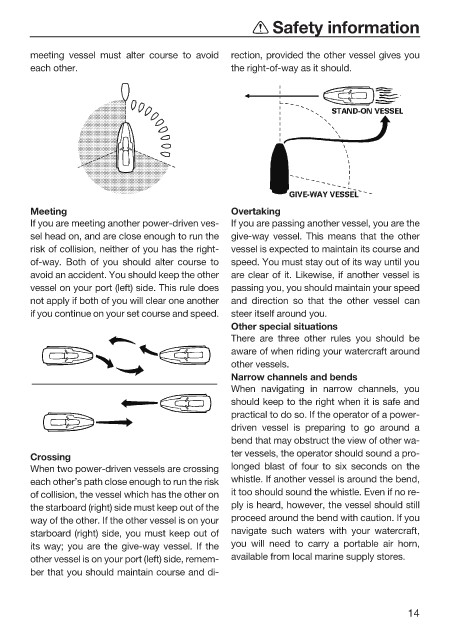
       Meeting                              Overtaking
       If you are meeting another power-driven ves-  If you are passing another vessel, you are the
       sel head on, and are close enough to run the  give-way vessel. This means that the other
       risk of collision, neither of you has the right-  vessel is expected to maintain its course and
       of-way. Both of you should alter course to  speed. You must stay out of its way until you
       avoid an accident. You should keep the other  are clear of it. Likewise, if another vessel is
       vessel on your port (left) side. This rule does  passing you, you should maintain your speed
       not apply if both of you will clear one another  and direction so that the other vessel can
       if you continue on your set course and speed.  steer itself around you.
                                            Other special situations
                                            There are three other rules you  should be
                                            aware of when riding your watercraft around
                                            other vessels.
                                            Narrow channels and bends
                                            When navigating in narrow channels, you
                                            should keep to the right when it is safe and
                                            practical to do so. If the operator of a power-
                                            driven vessel is preparing to go around a
                                            bend that may obstruct the view of other wa-
                                            ter vessels, the operator should sound a pro-
       Crossing
       When two power-driven vessels are crossing  longed  blast of four to six seconds  on  the
       each other’s path close enough to run the risk  whistle. If another vessel is around the bend,
       of collision, the vessel which has the other on  it too should sound the whistle. Even if no re-
       the starboard (right) side must keep out of the  ply is heard, however, the vessel should still
       way of the other. If the other vessel is on your  proceed around the bend with caution. If you
       starboard (right) side, you must keep out of  navigate  such waters with your  watercraft,
       its way; you are the give-way vessel. If the  you will need to carry a portable  air horn,
       other vessel is on your port (left) side, remem-  available from local marine supply stores.
       ber that you should maintain course and di-


                                                                             14

