


Page 17 - LIT-18626-12-56
P. 17
Safety information


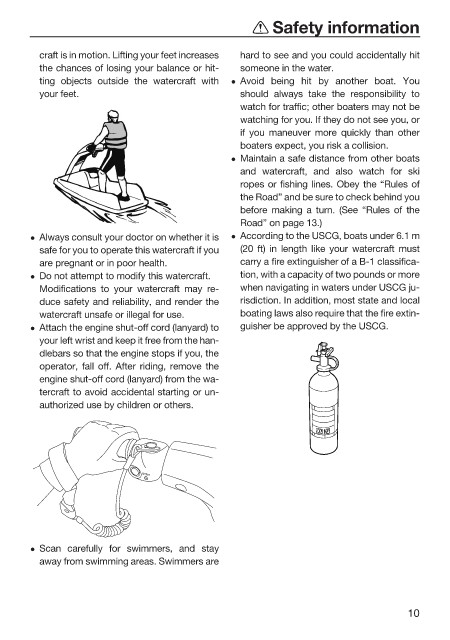
        craft is in motion. Lifting your feet increases  hard to see and you could accidentally hit
        the chances of losing your balance or hit-  someone in the water.
        ting objects  outside  the watercraft with  z Avoid being hit by another boat. You
        your feet.                            should always take the responsibility to
                                              watch for traffic; other boaters may not be
                                              watching for you. If they do not see you, or
                                              if you maneuver more quickly than other
                                              boaters expect, you risk a collision.
                                            z Maintain a safe distance from other boats
                                              and  watercraft,  and also watch for  ski
                                              ropes or fishing lines. Obey the “Rules of
                                              the Road” and be sure to check behind you
                                              before making a turn. (See “Rules of the
                                              Road” on page 13.)
       z Always consult your doctor on whether it is  z According to the USCG, boats under 6.1 m
        safe for you to operate this watercraft if you  (20 ft) in length like your watercraft must
        are pregnant or in poor health.       carry a fire extinguisher of a B-1 classifica-
       z Do not attempt to modify this watercraft.  tion, with a capacity of two pounds or more
        Modifications  to  your watercraft may re-  when navigating in waters under USCG ju-
        duce safety and reliability, and render the  risdiction. In addition, most state and local
        watercraft unsafe or illegal for use.  boating laws also require that the fire extin-
       z Attach the engine shut-off cord (lanyard) to  guisher be approved by the USCG.
        your left wrist and keep it free from the han-
        dlebars so that the engine stops if you, the
        operator, fall off. After riding, remove the
        engine shut-off cord (lanyard) from the wa-
        tercraft to avoid accidental starting or un-
        authorized use by children or others.


       z Scan carefully for swimmers, and stay
        away from swimming areas. Swimmers are


                                                                             10

