


Page 55 - LIT-18626-12-56
P. 55
Operation


        throwing the operator overboard, which  traveling  at speeds above trolling, you
        could cause an injury.                 will have rapidly  decreasing  ability to
                                               steer without throttle. You may still have
       Steering control depends on the combination
                                               some turning ability immediately after re-
       of handlebar position  and the amount of
                                               leasing the throttle lever, but once the
       throttle.
                                               engine slows down, the watercraft will no
       Water sucked in through the intake grate is
                                               longer respond to handlebar input until
       pressurized by the impeller in the jet pump.
                                               you  apply throttle again  or you reach
       As the pressurized water is expelled from the
                                               trolling speed.
       pump through the jet thrust nozzle, it creates
                                               At trolling speed, the watercraft can be
       thrust to move and steer the watercraft. The
                                               turned gradually by handlebar position
       higher the engine speed, the more thrust pro-
                                               alone using just the amount of thrust
       duced.
                                               available at idle.
       The amount of jet thrust, in addition to the po-
       sition of the handlebars, determines  how
       sharply you turn.
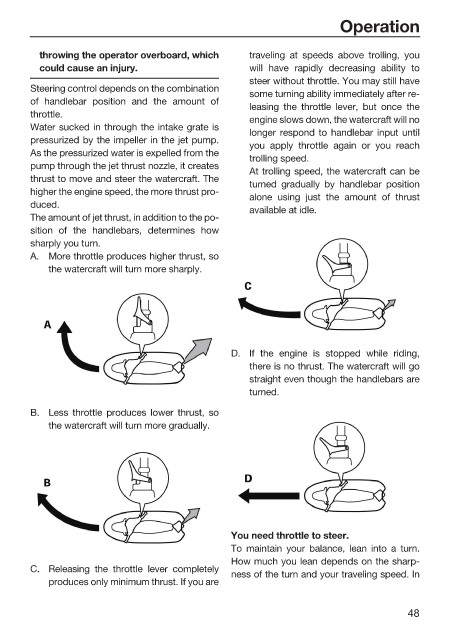
       A. More throttle produces higher thrust, so
          the watercraft will turn more sharply.


                                            D. If the engine is stopped  while riding,
                                               there is no thrust. The watercraft will go
                                               straight even though the handlebars are
                                               turned.

       B. Less throttle produces lower thrust, so
          the watercraft will turn more gradually.


                                            You need throttle to steer.
                                            To maintain  your balance,  lean into a  turn.
                                            How much you lean depends on the sharp-
       C. Releasing the  throttle lever completely
                                            ness of the turn and your traveling speed. In
          produces only minimum thrust. If you are

                                                                             48

