


Page 57 - LIT-18626-12-56
P. 57
Operation


       z Do not follow directly behind watercraft  The watercraft is less stable when at a stand-
        or other boats. Do not go near others to  still or at a slow speed. It takes skill to keep
        spray or splash them with water, go too  the watercraft upright when starting.
        close to other boats, or go too fast for  To stabilize the watercraft when accelerating
        the traffic conditions. Avoid sharp turns  to planing  speed, maintain  a  low center of
        or other maneuvers that make it hard for  gravity by operating it in the kneeling posi-
        others to avoid you or understand where  tion.
        you  are going. Avoid  areas with sub-  Even though it is easier to start in shallow wa-
        merged objects or shallow water.    ter, you must learn deep-water boarding first.
       z Take early action to avoid collisions. Re-  You will inevitably fall off,  so be sure you
        member, watercraft and other boats do  know how to get back on the watercraft once
        not  have brakes. Do  not release the  you are away from shore.
        throttle lever when trying to steer away  EJU33105
                                            Boarding and starting in shallow water
        from objects—as with  other power-
                                            Be sure to learn the deep-water  starting
        boats, you need throttle to steer.
                                            method  before operating  the watercraft in
       EWJ00634                             water where it is too deep for you to stand.
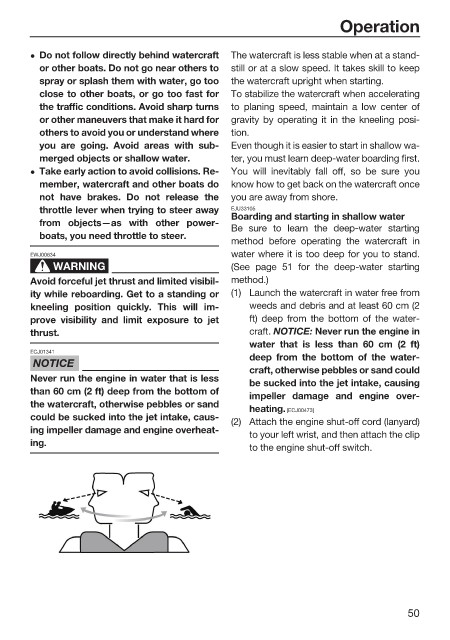
           WARNING                          (See  page 51 for the  deep-water  starting
       Avoid forceful jet thrust and limited visibil-  method.)
       ity while reboarding. Get to a standing or  (1) Launch the watercraft in water free from
       kneeling position quickly. This will im-  weeds and debris and at least 60 cm (2
       prove visibility and  limit exposure to  jet  ft) deep from  the bottom of the water-
       thrust.                                 craft. NOTICE: Never run the engine in
                                               water  that is less than 60  cm (2  ft)
       ECJ01341
       NOTICE                                  deep from the bottom of the water-
                                               craft, otherwise pebbles or sand could
       Never run the engine in water that is less
                                               be sucked into the jet intake, causing
       than 60 cm (2 ft) deep from the bottom of
                                               impeller damage and engine over-
       the watercraft, otherwise pebbles or sand
                                               heating. [ECJ00473]
       could be sucked into the jet intake, caus-
                                            (2) Attach the engine shut-off cord (lanyard)
       ing impeller damage and engine overheat-
                                               to your left wrist, and then attach the clip
       ing.
                                               to the engine shut-off switch.


                                                                             50

