


Page 52 - LIT-18626-12-56
P. 52
Operation


       EJU33172                             will probably need to return to the kneeling
       Operating positions
                                            position to maintain your balance.
       After you are underway, you may choose to
       kneel or stand, depending upon watercraft
       speed, your skill level, and your preference.
       Here are some guidelines.
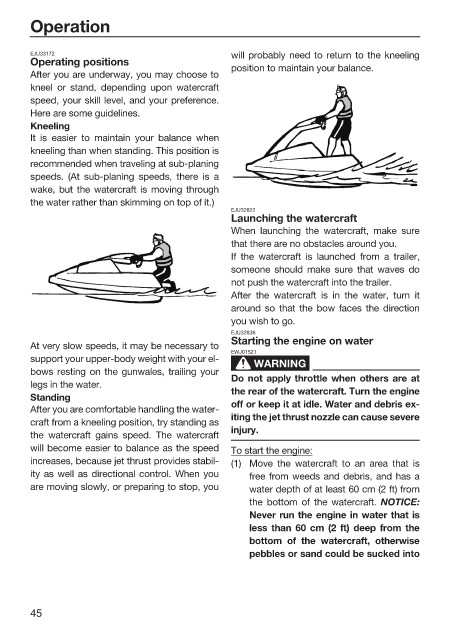
       Kneeling
       It is easier to maintain your balance when
       kneeling than when standing. This position is
       recommended when traveling at sub-planing
       speeds.  (At  sub-planing speeds, there is a
       wake, but the watercraft is moving through
       the water rather than skimming on top of it.)
                                            EJU32822
                                            Launching the watercraft
                                            When launching the watercraft,  make  sure
                                            that there are no obstacles around you.
                                            If the watercraft is launched from a trailer,
                                            someone should make sure that waves do
                                            not push the watercraft into the trailer.
                                            After the watercraft is in the water,  turn it
                                            around so that the bow faces the direction
                                            you wish to go.
                                            EJU32836
                                            Starting the engine on water
       At very slow speeds, it may be necessary to
                                            EWJ01521
       support your upper-body weight with your el-  WARNING
       bows resting on the gunwales, trailing your
                                            Do not apply throttle when others are at
       legs in the water.
                                            the rear of the watercraft. Turn the engine
       Standing
       After you are comfortable handling the water-  off or keep it at idle. Water and debris ex-
                                            iting the jet thrust nozzle can cause severe
       craft from a kneeling position, try standing as
                                            injury.
       the  watercraft gains  speed. The watercraft
       will become easier to balance as the speed  To start the engine:
       increases, because jet thrust provides stabil-  (1) Move the  watercraft to an  area  that is
       ity as well as directional control. When you  free from weeds and debris, and has a
       are moving slowly, or preparing to stop, you  water depth of at least 60 cm (2 ft) from
                                               the bottom of the watercraft. NOTICE:
                                               Never run the engine in water that is
                                               less than 60 cm (2 ft) deep from the
                                               bottom  of the watercraft, otherwise
                                               pebbles or sand could be sucked into


       45

